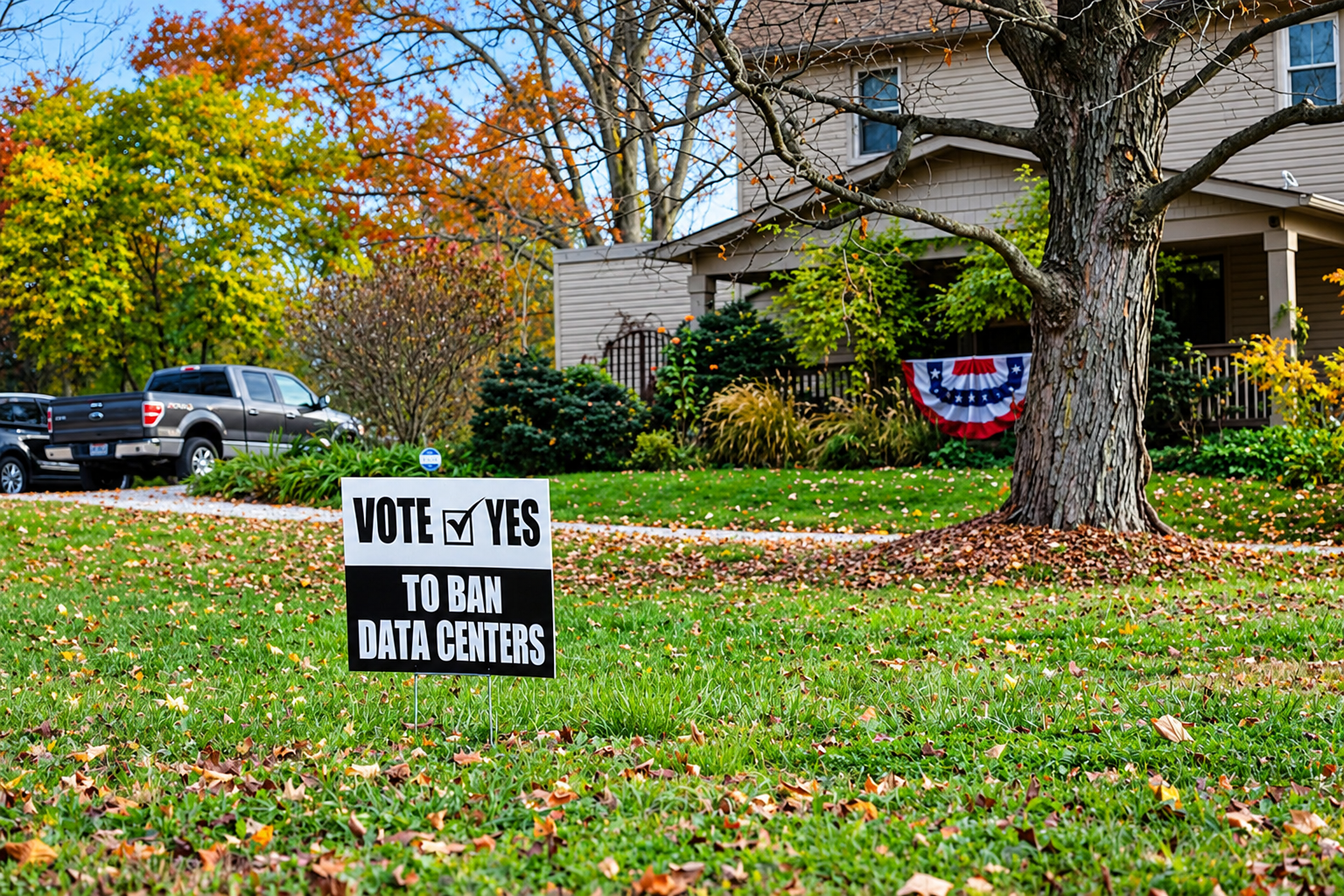
Voters across the country backed limits on AI data centers in most local contests on the Nov. 3 ballot, according to early tallies. Counts differ between trackers, and results are preliminary, Tom’s Hardware reported.
Key Highlights
- Data center measures appeared in about 40 localities across 13 states, 404 Media reported.
- Voters rejected the industry in 38 of those races “and counting,” 404 Media said.
- Tom’s Hardware, citing the Data Centers on the Ballot tracker, counted 33 restrictive measures won and 6 leading. One failed, and 5 had no posted results.
- Reuters reported that Democrats who ran partly on a data center moratorium won governorships in Texas and Georgia.
What Voters Decided
The measures included permanent bans, moratoriums, limits on power use, and votes on specific projects, Tom’s Hardware reported. Separate from those ballot questions, voters also recalled local officials who had supported data center projects, including the mayor of Yukon, Oklahoma, 404 Media reported.
Ohio had the most measures, with 21, according to Free Press Journal, which cited Ballotpedia and CNBC’s tally. That outlet counted 41 restrictive measures in 10 states.
The one failure reported was in Harwood, North Dakota, where voters rejected an extra review process for industrial projects, including data centers, per Tom’s Hardware.
Counts vary by tracker and by outlet. The numbers above are early and may change as ballots are tallied.
Local Races and Recalls
In Yukon, Oklahoma, the mayor lost a recall after supporting a hyperscale data center project, 404 Media reported. Tom’s Hardware also reported a recall of the mayor and two council members in Piqua, Ohio, though it described the reasons ambiguously.
Emporia, Kansas, passed a ban on high-impact data centers, 404 Media said. In Asheville, North Carolina, and San Marcos, Texas, mayors were elected after anti-data-center campaigns.
The Texas and Georgia Governor Races
Democrat Gina Hinojosa won the Texas governor’s race, defeating Republican Gov. Greg Abbott, who sought a fourth term. 404 Media reported she made his data center stance central to her campaign.
Abbott had announced a pause on new data center projects. 404 Media reported regulators kept approving projects. It also cited Texas Tribune reporting that Abbott accepted more than $9 million from data center-related donors.
In Georgia, Keisha Lance Bottoms won the governorship, Free Press Journal reported, citing Reuters. Texas accounts for roughly a quarter of U.S. data center capacity due online by 2030, per GLJ Research, as cited by Reuters.
What Organizers and Analysts Say
Michael Whitesides of Local Progress, a network of local officials, told 404 Media: “These midterms sent a clear message — people don’t want to see data centers in their backyards.”
Aidan Yao of the Amundi Investment Institute told Reuters the election “looked more like a referendum on AI than on President Donald Trump.” Analysts expect tighter oversight more than broad bans, and some projects may move to other states, per Free Press Journal.
Election Aftermath and Market Reaction
By Nov. 6, the Associated Press reported that 32 of 34 winning gubernatorial candidates supported stronger restrictions on data centers, while 44 of 45 completed municipal referendums favored restrictions. The figures reflect different types of contests and should not be treated as one national vote total, AP said.
The market reaction was also sharp. Reuters reported that the Nasdaq Composite fell 5.5% on Nov. 5, while the Nasdaq 100 dropped 6.4%, amid investor concerns that election results could bring tighter scrutiny, local opposition and permitting delays for AI data center projects. Reuters said the selloff erased about $2.5 trillion in Nasdaq market value. These market moves show investor concerns, not proof that projects will be canceled.
What Remains Uncertain
The effect on projects already under way is unclear, Free Press Journal reported. Slower U.S. construction does not necessarily mean weaker demand for AI computing, it added.
Polling is mixed. Stateline reported an NBC exit poll in which 56% of voters called AI and data centers a crucial or major factor. A Marquette poll in Wisconsin showed strong opposition, but voters ranked data centers below cost of living, immigration and the economy, per Wisconsin Public Radio.
We have not independently verified the tallies or the exit poll. For wider context, see our report on the 2026 midterm elections.
Sources: Associated Press (Nov. 6); Reuters (Nov. 5); Tom’s Hardware (Nov. 4); 404 Media (Nov. 4); Free Press Journal (Nov. 5).
3 thoughts on “AI Data Center Backlash Grows After Midterms as Voters Back Limits in Dozens of Local Votes”