


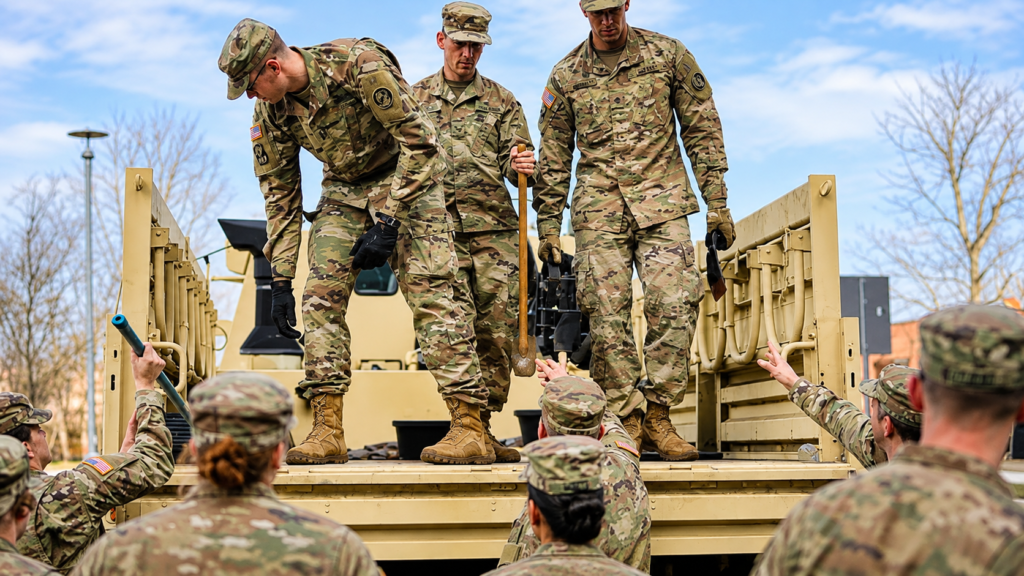
Senior Army National Guard leaders say a major war with a peer or near-peer rival could pull large numbers of Guard soldiers away from their home states, leaving governors with fewer troops for hurricanes and other emergencies. The warning came at a National Guard seminar, according to a National Guard Bureau statement republished by MilitarySpot and Defcon Level. It describes planning for a possible future conflict, not a shortage that exists today.
Key Highlights
- Leaders said a peer conflict would likely lead to federalizing the Army Guard on a large scale.
- The Army Guard has more than 329,000 soldiers, the statement said.
- Lt. Gen. Jonathan Stubbs said, “Hurricanes will not take a break for great power war.”
- Proposed fixes include state defense forces and a system to allocate troops quickly.
What Was Said and Where
The remarks came at the Director of the Army National Guard Seminar during the Association of the United States Army annual meeting. The reports reviewed did not give the seminar date.
Stubbs, the director of the Army National Guard, hosted the panel. He called the dual mission of preparing for war and supporting states “a no-fail mission,” according to the statement.
The Core Concern: Simultaneity
The panel warned about what it called “simultaneity,” meaning overseas mobilization and homeland emergencies arriving at the same time. The statement said that during partial mobilization governors may have fewer Guard forces available.
Maj. Gen. Larry Muennich, Indiana’s adjutant general, said, “The joint force headquarters in your state will be absolutely stressed.” He also asked what would be “left for the governor in a contested homeland,” according to Defcon Level.
Muennich said many people running Camp Atterbury, Indiana’s mobilization installation, are not from Indiana and may have trouble reporting from their home states. Indiana must also mobilize units such as the 38th Infantry Division and the 76th Mobile Brigade, the statement said.
Domestic Missions at Stake
The statement listed responses to natural and human-caused disasters, cyberattacks and attacks on critical infrastructure. It also listed protecting critical infrastructure and supporting governors, law enforcement and federal agencies.
Maj. Gen. Brey Hopkins, a deputy commanding general at U.S. Army Western Hemisphere Command, also described homeland defense work such as static security at multiple locations and roving patrols within a state.
Proposed Solutions
- State forces: Maj. Gen. Bob Carruthers, commander of the Florida Army National Guard, said Florida has reactivated the Florida State Guard to fill gaps. The statement said it can include up to 1,500 state-trained volunteers.
- Allocation: Maj. Gen. Jack James proposed an arbiter to assign forces quickly when demands compete.
- Cyber: Muennich suggested a civilian cyber corps and stronger state-level resilience.
- Mobilization: Hopkins suggested decentralizing mobilization for homeland missions. He said, “Demonstrated mobilization proficiency is a component of strategic deterrence.”
What This Does and Does Not Mean
The warning is framed around a hypothetical conflict. The reports reviewed did not tie it to any current war or name a specific shortfall in any state.
Business Insider headlined its own report that a major war “could leave US states without enough National Guard troops for disasters and other emergencies, generals warn,” according to a BizToc listing. Only the headline and summary of that report were available for review.
Stubbs also described the Guard as a “fight-tonight” homeland force that can pivot to overseas missions, the statement said.
What to Watch Next
Key questions are whether other states copy Florida’s state guard approach, whether the Pentagon adopts an allocation process and how governors plan for long deployments. For related coverage of defense oversight, see our report on Hegseth’s vow to fight impeachment as Democrats prepare Pentagon investigations.
Watch: How the Guard Responds to Hurricanes
Background video: “How the National Guard responded to Hurricane Milton” (YouTube). It shows a past disaster response and is not coverage of this seminar.
Sources
- U.S. Army: Army Guard leaders urge civilian leaders to plan for domestic operations during war
- MilitarySpot (National Guard Bureau): Guard Leaders Urge Civilian Leaders to Plan for Domestic Operations During War
- Defcon Level (National Guard Bureau): Army Guard leaders urge civilian leaders to plan for domestic operations during war
- BizToc (Business Insider headline): A major war could leave US states without enough National Guard troops for disasters and other emergencies, generals warn