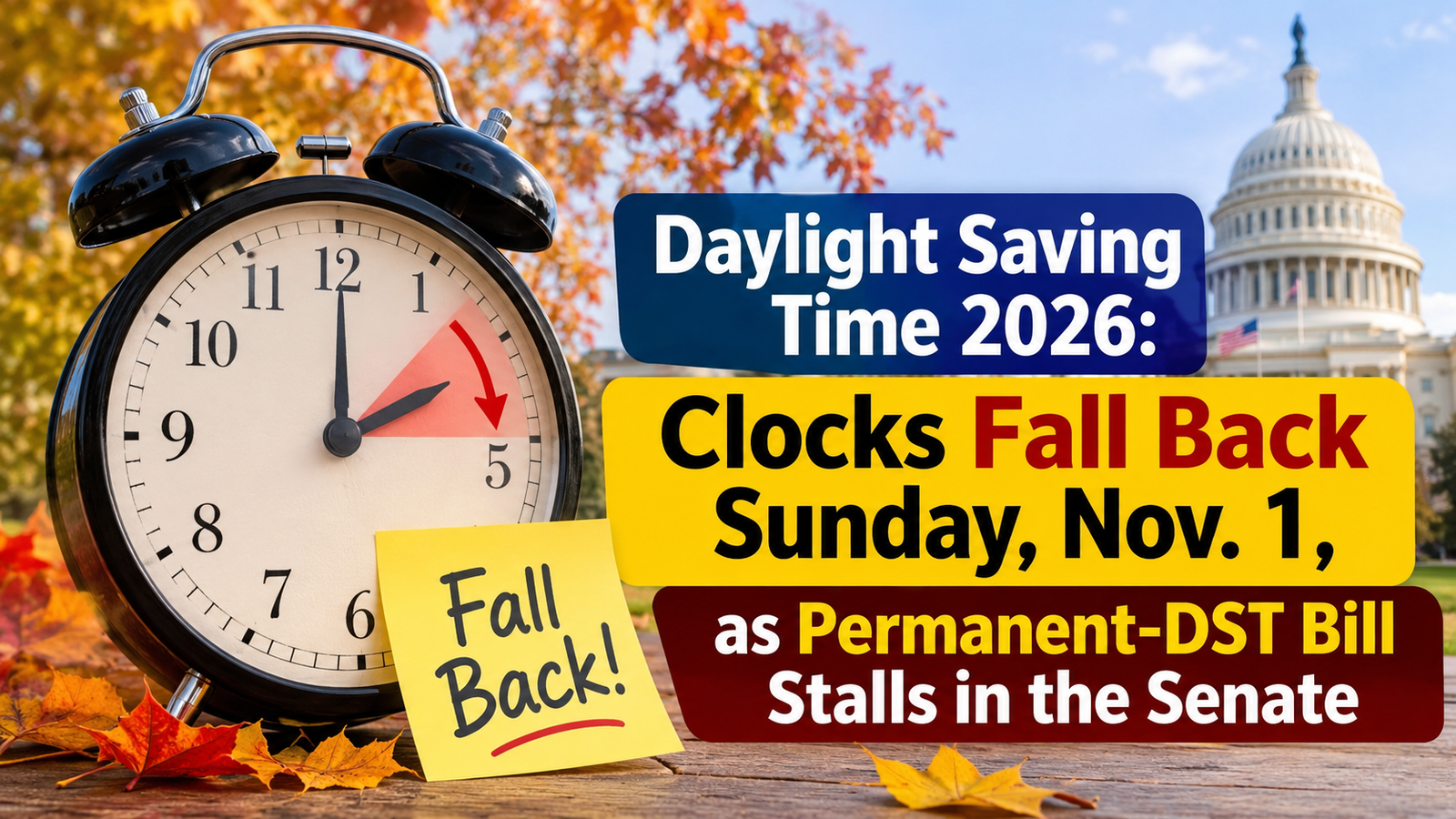
Most Americans set their clocks back one hour early Sunday, Nov. 1, ending daylight saving time for 2026. The change took effect at 2 a.m. local time, when clocks moved back to 1 a.m., according to FOX 5 New York.
Key Highlights
- Daylight saving time ended Sunday, Nov. 1, 2026, at 2 a.m. local time.
- Hawaii and most of Arizona do not change their clocks.
- The House passed the Sunshine Protection Act 308-117 in July, but it has not become law.
- The Senate is unlikely to vote on the bill before the end of 2026, the Associated Press reported on Oct. 29.
When Did Clocks Fall Back in 2026?
The switch back to standard time happened across most of the United States and Canada on Sunday, Nov. 1, Forbes reported.
The extra hour means sunrise and sunset arrive about an hour earlier, so evenings get dark sooner, FOX 5 New York reported.
The change comes two days before Election Day on Tuesday, Nov. 3. For more on the races and issues in play, see our report on the 2026 midterm elections.
Which Clocks Need to Be Changed by Hand?
Smartphones, computers and connected smart home devices update on their own, according to FOX 5 New York.
Analog wall clocks, car dashboards, microwaves and ovens usually need to be reset by hand. The outlet advised doing so before bed on Saturday, Oct. 31.
Who Does Not Change Clocks?
Hawaii and most of Arizona stay on standard time all year, FOX 5 New York reported.
The same is true in Puerto Rico, the U.S. Virgin Islands, Guam, American Samoa and the Northern Mariana Islands.
Why the Change Still Happens
The schedule comes from the Uniform Time Act of 1966. Under that law, daylight saving time begins on the second Sunday in March and ends on the first Sunday in November, FOX 5 New York reported.
Because Congress has not changed that law, it still applies, Forbes reported.
Where the Sunshine Protection Act Stands
The Sunshine Protection Act would make daylight saving time permanent. The House passed it 308-117 on Tuesday, July 14, according to a New York Times report republished by The Philadelphia Inquirer.
The Senate sent the bill to its Commerce, Science, and Transportation Committee the next day, Forbes reported. That committee has not voted on it, FOX 29 Philadelphia reported in September.
The Inquirer report said the bill “faces an uncertain path to enactment.” It also reported that Senate Republican leader John Barrasso said it was unclear what would happen once the measure reached the Senate.
President Donald Trump pressed the Senate on Truth Social on Oct. 26. “The United States Senate is letting the Daylight Saving Bill die, when a vast Majority of the Country want it,” he wrote, adding, “TAKE A VOTE!” Spectrum News reported the quotes.
The Senate passed a similar bill unanimously in 2022, but the House never acted on it, according to the same Times report.
What Comes Next
Unless Congress acts, daylight saving time returns on Sunday, March 14, 2027. Clocks will move forward from 2 a.m. to 3 a.m., FOX 5 New York reported.
What Remains Uncertain
Whether the Senate will take up the bill after this year is unclear. Spectrum News reported that no vote is expected in 2026, but that is an expectation, not a scheduled action.
This article relies on the published reports linked above. We did not independently verify the bill’s committee status beyond those reports.
Sources: FOX 5 New York (Oct. 21); Forbes (Oct. 26); Spectrum News (Oct. 30); The Philadelphia Inquirer / NYT (July 15); FOX 29 Philadelphia (Sept. 21).